
Surveillance Awareness Training in Belfast – From Awareness to Real World Application
- davidholdsworth78
- 7 days ago
- 3 min read

Why Surveillance Awareness Training Matters
Surveillance is often misunderstood.
For many, it brings to mind intelligence agencies, covert teams, and highly specialised operations. In reality, the principles of surveillance are far more common, and far more relevant, than most people realise.
At its core, surveillance is about observation.
It is the ability to recognise patterns, understand behaviour, and identify when something does not quite fit. These are not skills limited to specialists. They are skills used every day by security professionals, journalists, corporate teams, and anyone operating in unfamiliar or high pressure environments.
WHERE SURVEILLANCE SITS TODAY
Modern operating environments have changed.
People move more, information moves faster, and environments are often less predictable than they were even a decade ago. Whether working in a major city or a more fragile setting, individuals are exposed to a wider range of risks, many of which are not immediately obvious.
Surveillance, in its simplest form, helps bridge that gap.
It allows individuals to slow things down, take in their surroundings, and build a clearer picture of what is happening around them.
This might be:
• Noticing repeated presence in an area
• Recognising behaviour that does not match the environment
• Identifying patterns in movement or timing
• Understanding when attention is being directed towards you or your team
Most of the time, these indicators are subtle. Without the right mindset, they are easy to miss.
WHO USES THESE SKILLS
While surveillance techniques are rooted in specialist fields, the awareness behind them is widely applicable.
In practice, these skills are used by:
• Security managers overseeing personnel and assets
• Media teams working in unfamiliar or sensitive locations
• Corporate staff travelling internationally
• Close protection teams and drivers
• Individuals operating independently in new environments
In many cases, people are already using elements of surveillance awareness without formal training. The difference is consistency and structure.
WHY AWARENESS IS THE STARTING POINT
Before any technical skill, there is awareness.
Without it, even the best procedures or plans can fall short. With it, individuals are better positioned to make informed decisions, adjust their behaviour, and reduce unnecessary risk.
Awareness is not about paranoia. It is about balance.
It is the ability to remain alert without drawing attention, to observe without overreacting, and to act only when something genuinely stands out.
This is where structured training becomes useful. It provides a framework for something that is often instinctive but unrefined.
THE ROLE OF ENVIRONMENT IN SURVEILLANCE TRAINING
One of the most overlooked aspects of surveillance is the environment itself.
Skills learned in a classroom or controlled setting only go so far. Real understanding comes from applying those skills in places where variables cannot be controlled.
That is why environment matters.
Cities with pace, variation, and natural complexity create a far more demanding training ground. They force individuals to filter noise, prioritise information, and make decisions based on what they actually see rather than what they expect to see.
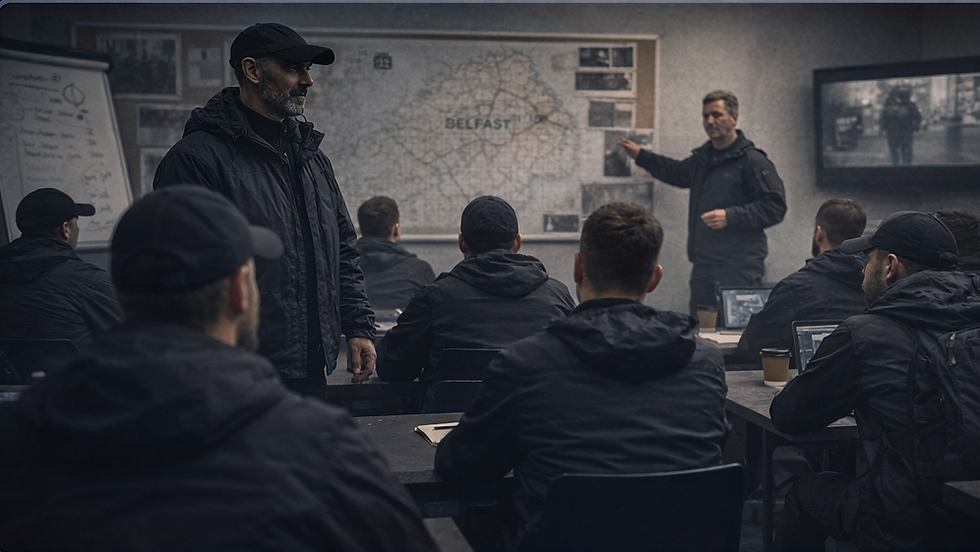
This is one of the reasons we utilise Belfast as a training environment.
It is a city where awareness has long been part of everyday life. The pace, the layout, and the people create a setting that challenges observation in a way that cannot easily be replicated.
You are not working through a scripted exercise. You are working within a live environment where things change, distractions are real, and decisions matter.
FROM AWARNESS TO REAL WORLD SURVEILLANCE TRAINING
There is a clear difference between understanding surveillance and applying it.
Learning the principles is one step. Applying them in real time, under pressure, and in a changing environment is another.
That is why a structured approach works best.
Starting with awareness allows individuals to understand what to look for and why it matters. From there, practical training introduces movement, positioning, and decision making within real environments.
Both stages have value.
One builds understanding. The other builds capability.

KEEPING IT REALISTIC
There is a tendency in training to overcomplicate or over dramatize surveillance.
In reality, the most effective skills are often the simplest. They rely on observation, patience, and the ability to stay calm and focused.
Training should reflect that.
It should be realistic, relevant, and grounded in how people actually operate, not how scenarios are imagined.
When done properly, surveillance awareness becomes less about “technique” and more about mindset.
FINAL THOUGHT
Surveillance is not just a specialist capability.
It is a way of understanding the environment around you, recognising when something changes, and responding appropriately.
In a world where environments are increasingly unpredictable, that awareness is not just useful. It is necessary.


Comments